

Article: Massage Chair Recovery: The Physiology of Mechanical Decompression
Massage Chair Recovery: The Physiology of Mechanical Decompression
There is a category of recovery tool that gets underestimated precisely because it asks nothing of you. Cold plunges require tolerance. Sauna demands time and heat adaptation. Breathwork takes deliberate practice. Sit in a massage chair or run a percussion device over a sore quad, and the work happens without your participation. That frictionlessness is not a design flaw — it is what makes mechanical recovery sustainable as a daily habit. And the physiology behind it is more substantive than the category's reputation suggests.
Two Tools, Two Scales of Action
Massage chairs and percussion devices both apply mechanical force to soft tissue. The inputs differ in scale and precision; the downstream effects overlap considerably.
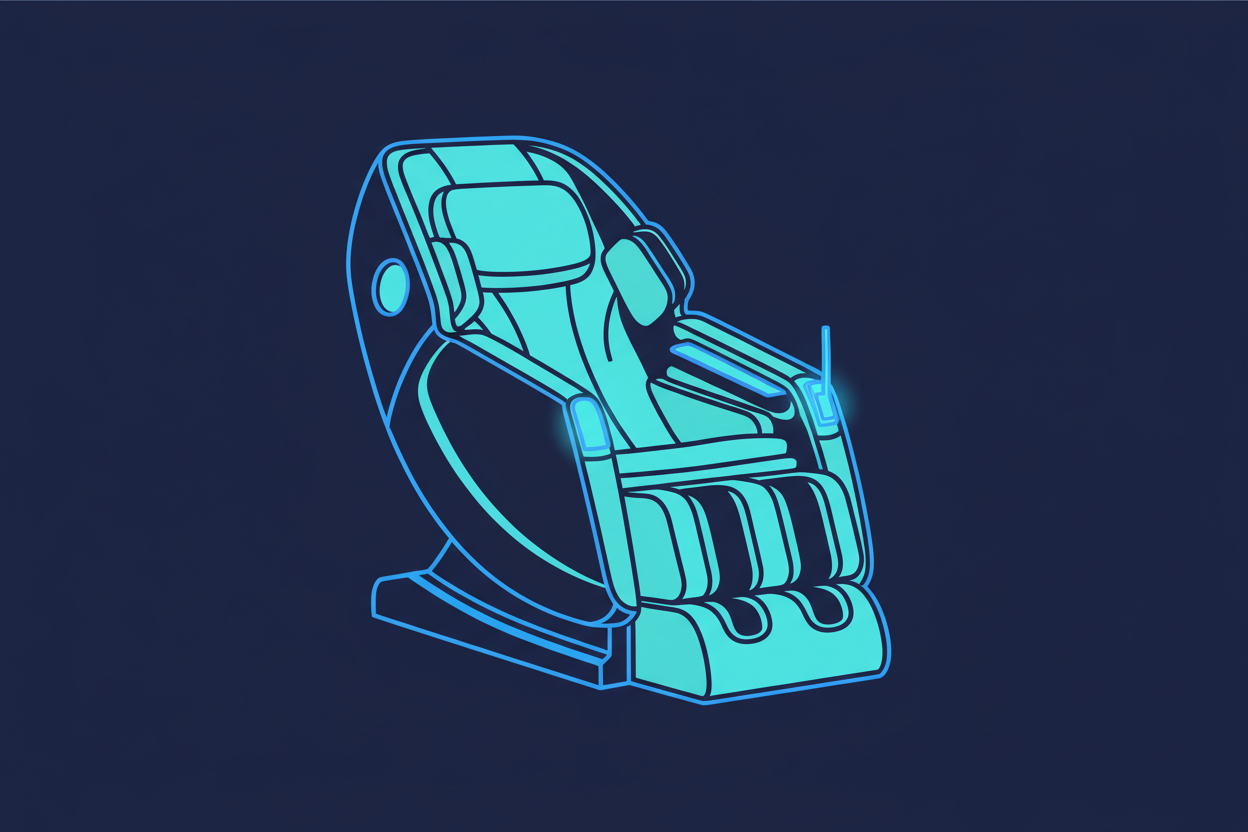
A massage chair works at the system level. Rollers trace the length of the spine. Airbags compress the shoulders, calves, and feet. Heating elements warm the lumbar region. Stretch programs mobilize the hips and thoracic spine. The cumulative effect is global decompression — accumulated tension released across large muscle groups while the autonomic nervous system is nudged toward parasympathetic dominance. Lower heart rate. Reduced cortisol drive. The physiological conditions under which recovery actually occurs.
A percussion device works at the tissue level. Rapid pulses delivered directly to a target muscle penetrate into the muscle belly, alter the viscoelastic properties of the tissue, stimulate mechanoreceptors, and interrupt local pain signaling. The effect is immediate and specific. A chronically tight upper trap or locked calf responds within a minute or two of focused work in a way that foam rolling rarely achieves.
Used together, they cover different parts of the recovery problem — one broad, one precise.
What the Evidence Shows
Delayed onset muscle soreness. DOMS — the stiffness and pain that peaks 24 to 72 hours after hard training — is one of the most studied targets for percussion therapy. Randomized trials consistently show lower soreness scores and better range of motion in the recovery window compared to static stretching or passive rest. Systematic reviews from 2021 through 2025 support percussion devices as a reliable tool for post-exercise soreness across lifting, endurance, and tactical populations. The effect is not subtle.
Flexibility and range of motion. Five to eight minutes of percussion on a target muscle group produces immediate flexibility gains that outperform foam rolling in controlled settings. Hamstring flexibility — measured by straight-leg raise and active knee extension — improves without any corresponding drop in muscle strength. That combination makes percussion a practical pre-training tool: open up tight hips and hamstrings before squats or sprints without compromising force output.
Pain signaling. Percussion activates mechanoreceptors in the skin and muscle, engaging the nervous system's gate control mechanism — a process by which non-painful sensory input competes with and attenuates pain signals before they reach the brain. This is a well-characterized neurological pathway, not a masking effect. Consistent use as part of a broader protocol has shown short-term relief of musculoskeletal pain across several reviews.
Autonomic state. Massage chair studies in high-stress populations — including healthcare workers — show significant reductions in stress and depression scores after six to twelve sessions. The mechanism is parasympathetic activation: full-body pressure, warmth, and rhythmic movement signal safety to the nervous system and pull it out of sympathetic drive. Blood pressure drops modestly in some users. Mental fatigue scores improve. The effect accumulates with regular use rather than appearing all at once.
Chronic work-related pain. In office worker populations, eight to twelve weeks of regular massage chair use produced meaningful decreases in neck and shoulder pain, increased pressure pain thresholds, and improved quality-of-life scores. Some clinical comparisons have found massage chair programs comparable to supervised physiotherapy for certain chronic low back pain outcomes — a relevant finding for anyone managing recurring discomfort without consistent access to hands-on care.
Quick Reference: How to Deploy Each Tool
| Tool | Duration | Primary Effect | Best Timing |
|---|---|---|---|
| Massage Chair | 15–30 min | Full-body decompression, parasympathetic shift, stress reduction | Post-training, end of workday, pre-sleep |
| Percussion Device | 1–2 min per muscle group | DOMS reduction, ROM improvement, trigger point release | Pre-training warm-up or post-training cool-down |
| Both Combined | Gun first on target areas, chair after | Targeted tissue prep followed by full-body recovery | After heavy training days or long work shifts |
The Case for Daily Use
The clinical literature on massage chairs is built on frequency, not intensity. The reductions in pain, tension, and stress scores that appear in the research come from regular sessions — not occasional long ones. A 20-minute chair session most evenings will outperform a 60-minute session once a week in terms of sustained autonomic benefit. The nervous system adapts to what it encounters repeatedly.
Used before sleep, the parasympathetic shift from a chair session creates favorable conditions for sleep onset: lower heart rate, reduced cortisol, relaxed musculature. Ongoing clinical trials are examining 30-minute pre-bed protocols specifically for insomnia and sleep quality outcomes. The early signals are consistent with what the autonomic data would predict.
What makes this viable as a daily habit is the absence of a decision cost. A cold plunge requires you to choose it every time. A massage chair does not. That distinction matters more than it sounds when you are trying to build a recovery practice that holds up across a demanding week.
Where Mechanical Recovery Fits in the Stack
Cold exposure and sauna produce hormetic adaptation — they stress the system to generate a response. That stress has a cost, and it needs to be managed. Mechanical recovery does not stress the system. It restores it. That makes it the appropriate daily baseline: the tool you use consistently because it costs nothing in terms of recovery from the recovery itself.
A practical protocol for high-output days: cold plunge or contrast therapy for the acute neurochemical and anti-inflammatory response, followed by a massage chair session in the evening to complete the parasympathetic shift and prepare for sleep. The percussion device handles targeted tissue work at either end of training. Each tool occupies a distinct role; none of them substitute for the others.
For more on the cold and heat side of this equation, see our coverage of contrast therapy and cold plunge health benefits.
The Rebel 4D
The Floridian Brand Rebel 4D Massage Chair is built for the kind of daily, high-frequency use the research supports. Four-dimensional roller movement replicates the variable pressure and rhythm of a skilled therapist across the full spinal column. Zero-gravity positioning unloads the lumbar spine and improves circulation during the session. Airbag compression covers the shoulders, arms, calves, and feet simultaneously — the full-body coverage that drives the autonomic shift the clinical literature describes.
Complimentary freight delivery is included with every Rebel order (valued at $250–$400). Price match guarantee applies.
Safe Use
Keep percussion device work to two to three minutes per muscle group. Let the device do the work — avoid pressing hard into bone, joints, or the spine. For massage chairs, start with 15-minute sessions and build toward 30 minutes as your body adapts. Hydrate before and after. Stop immediately if you experience dizziness, sharp pain, or anything unusual. Consult a healthcare provider before use if you have cardiovascular conditions, blood clotting disorders, osteoporosis, implanted devices, or are pregnant.
Conclusion
Mechanical recovery tools are not the most dramatic part of a serious protocol. They are the most consistent part. The physiology is real, the evidence is solid, and the barrier to daily use is lower than any other recovery modality in the stack. That combination — meaningful benefit, minimal friction — is what makes them worth building a habit around.
For more on the full recovery picture, visit our Health Benefits Research Library or explore the evidence on infrared sauna benefits and cold plunge health benefits.
References
Primary sources. Listed in approximate order of evidentiary weight.
- Konrad, A., et al. (2025). Acute effect of percussion and foam roller massage on flexibility and muscle strength. PMC. https://pmc.ncbi.nlm.nih.gov/articles/PMC12579856/
- Imtiyaz, S., Veqar, Z., & Shareef, M. Y. (2014). To compare the effect of vibration therapy and massage in prevention of delayed onset muscle soreness (DOMS). Journal of Clinical and Diagnostic Research, 8(1), 133–136.
- Dupuy, O., et al. (2018). An evidence-based approach for choosing post-exercise recovery techniques to reduce markers of muscle damage, soreness, fatigue, and inflammation. Frontiers in Physiology, 9, 403.
- Cheatham, S. W., et al. (2021). Mechanical percussion devices: A survey of practice patterns among healthcare professionals. International Journal of Sports Physical Therapy, 16(3), 766–777.
- Sefton, J. M., et al. (2011). Physiological and clinical changes after therapeutic massage of the neck and shoulders. Manual Therapy, 16(5), 487–494.
- Kang, S. Y., et al. (2023). Effect of a massage chair on neck and shoulder pain in office workers: A randomized controlled clinical trial. PMC. https://pmc.ncbi.nlm.nih.gov/articles/PMC10520820/
- Romanowski, M. W., et al. (2020). Clinical outcomes and cost-effectiveness of massage chair therapy versus physiotherapy for chronic low back pain. PMC. https://pmc.ncbi.nlm.nih.gov/articles/PMC7220115/
- National Center for Complementary and Integrative Health (NIH). Massage therapy: What you need to know. https://www.nccih.nih.gov/health/massage-therapy-what-you-need-to-know
Medical Disclaimer: The information in this article is provided for educational purposes only and is not intended as medical advice, diagnosis, or treatment. Massage chairs and percussion devices are not intended to diagnose, treat, cure, or prevent any disease. Consult a qualified healthcare provider before beginning any new recovery regimen, particularly if you have cardiovascular conditions, blood clotting disorders, osteoporosis, neurological conditions, implanted devices, or are pregnant. Individual results vary.

Leave a comment
This site is protected by hCaptcha and the hCaptcha Privacy Policy and Terms of Service apply.