

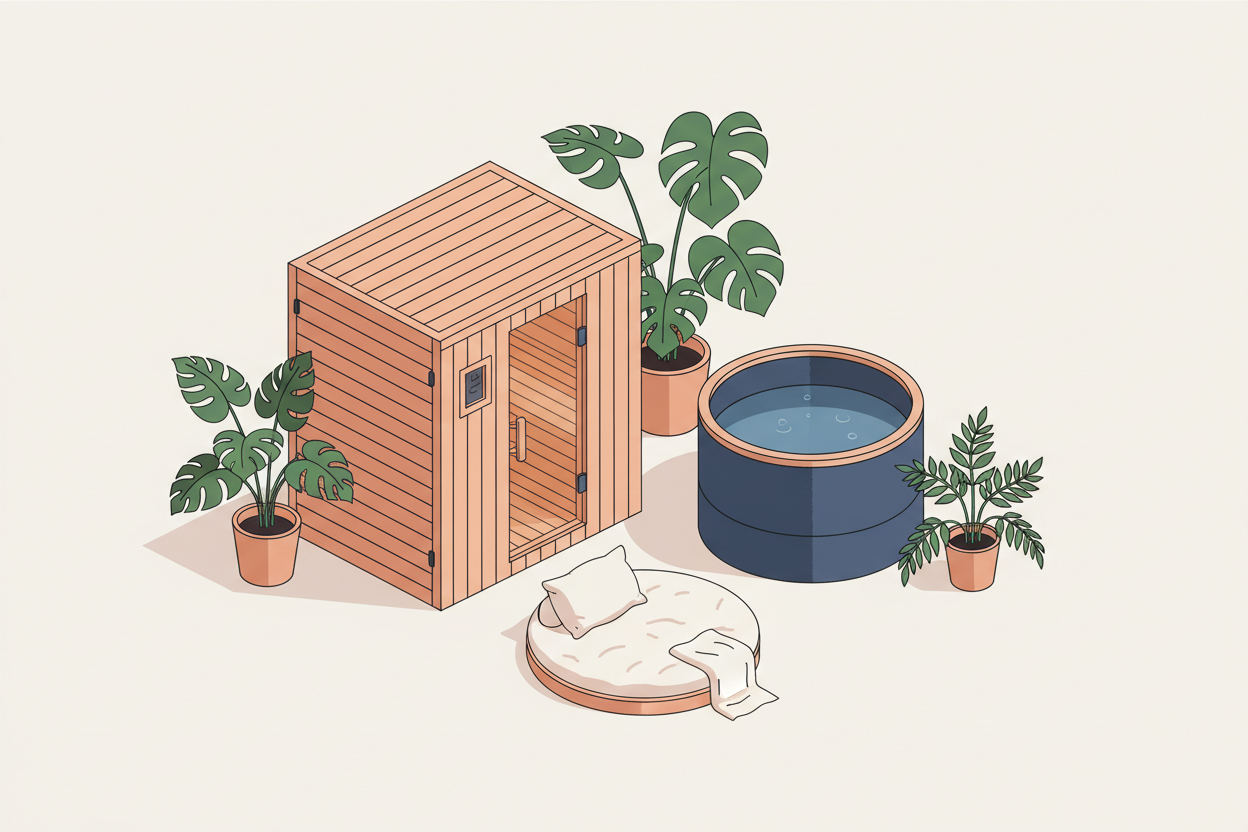
5 Ways to Build a Home Wellness Routine Around Your Sauna
A sauna isn’t just a piece of equipment — it’s an anchor. When you build a wellness routine around it, everything else falls into place more naturally: sleep improves, stress becomes manageable, recovery accelerates, and the ritual itself becomes something you protect rather than skip. Here are five ways to make your sauna the centerpiece of a home wellness practice that actually sticks.
1. Start with heat, end with cold
The most powerful thing you can pair with a sauna is a cold plunge. The sequence — heat, cold, rest, repeat — is the foundation of contrast therapy, one of the most evidence-backed recovery protocols available. Heat dilates blood vessels and elevates core temperature. Cold constricts them and triggers a norepinephrine spike. The alternation trains your cardiovascular system, accelerates muscle recovery, and produces a mental clarity that’s hard to replicate any other way.
Even without a dedicated cold plunge, a cold shower between rounds works as a starting point. But if you’re serious about the protocol, a temperature-controlled tub is the difference between a practice and a ritual. Learn the science behind contrast therapy →
2. Use it as a daily decompression window
The sauna is one of the few places where doing nothing is the point. No phone, no notifications, no decisions. A 15–20 minute session forces a kind of stillness that’s increasingly rare — and the heat itself drives cortisol down and parasympathetic activation up. Many users report that a consistent evening sauna session is the single most effective thing they’ve done for sleep quality.
Treat it like a meeting you can’t cancel. Same time, same duration, same space. The ritual consistency is as valuable as the heat itself.
3. Pair it with breathwork
Heat and breathwork are a natural combination. The elevated heart rate and vasodilation from sauna heat create a physiological state that’s highly receptive to breath-based nervous system regulation. Box breathing (4 counts in, 4 hold, 4 out, 4 hold) or simple slow exhale breathing during your session can deepen the parasympathetic response and extend the post-sauna calm significantly.
This is also excellent preparation for cold plunging — the breath control you practice in the heat translates directly to managing the cold shock response.
4. Build your recovery stack around it
The sauna works best as part of a system, not in isolation. A simple recovery stack that compounds well:
- Pre-sauna: light movement or stretching to warm up and increase circulation
- During sauna: hydration, breathwork, stillness
- Post-sauna: cold plunge or cold shower, natural rewarming, magnesium or electrolytes
- Evening: low light, no screens, early sleep window
Each element reinforces the others. The sauna is the anchor that makes the rest of the stack feel intentional rather than arbitrary.
5. Protect the ritual
The biggest threat to any wellness routine isn’t motivation — it’s friction. The advantage of a home sauna is that the friction is nearly zero. No drive, no membership, no waiting. It’s there when you need it, at the temperature you set, on your schedule.
That accessibility is what turns a practice into a habit. And habits, compounded over months and years, are where the real results live — the cardiovascular adaptations, the sleep improvements, the stress resilience that becomes your baseline rather than your exception.
Explore our outdoor saunas and infrared saunas to find the right fit for your space and routine.
This content is for informational and educational purposes only and is not intended as medical advice. Consult a qualified healthcare professional before beginning any heat therapy protocol, particularly if you have cardiovascular conditions, hypertension, or other health concerns.


Leave a comment
This site is protected by hCaptcha and the hCaptcha Privacy Policy and Terms of Service apply.